Waste Scenes by Maia Chao & Fred Schmidt-Arenales
essay by Alex Santana
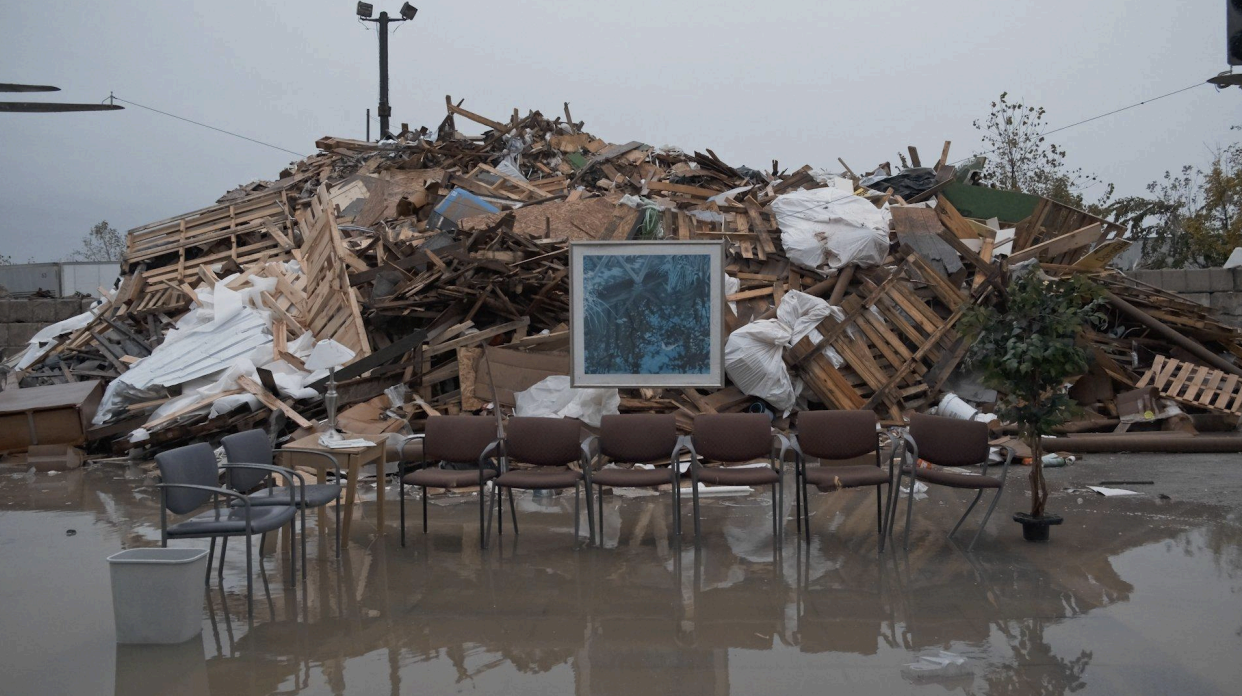
Waste Scenes: Like Drivel and Like Sawdust The dump is a site of destruction but also a site of possibility. In Waste Scenes, it is a reparative space for imagining new modes of dissolution after years of endless maximalist production. It is a fertile chasm where objects can return to a state closer to their origins as raw materials – paper is shredded one step closer to pulp, wooden furniture is shattered inching closer to sawdust, metal fixtures are compressed into dense solid matter, able to be reduced or melted into other forms. In this video co-directed by Maia Chao and Fred Schmidt-Arenales and expertly edited by Chelsea Knight, solid yet decentralized stuff is juxtaposed with the textual, visual, and sonic ephemera that contextualizes it. This includes self-help books, infomercials, workout videos, marketing workshops, sports montages, managerial manuals, motivational speeches, and employee handbooks. Waste Scenes is an experimental amalgamation of affect scraped from our post-industrial society of the last forty years, what Schmidt-Arenales calls “the top layer of scum on the pond of neoliberal capitalism.”
These varied objects and ephemera are all sourced from the wasteland, which in itself is a container but also a character that somehow both absorbs and also resonates its own grief. In this landscape, a fleet of 1-800-GOT-JUNK trucks comes and goes, like clockwork, disposing of broken promises and shared delusions. In one scene, a gray corporate cubicle is easily demolished by the claw of an excavator, emphasizing the insignificance of that office setting––a ghost of unbridled, optimistic careerism that today feels very absurd and hopeless. In another scene, the contents of a waiting room are discarded, then reassembled in suspense, only to be destroyed again at the dump site. This action produces both heartbreak and a kind of satisfactory catharsis––evoking the many frustrations of the waiting room and what it implies––precarious healthcare, bureaucratic roadblocks, inaccessible welfare.
In Waste Scenes, material ephemera reflects our civilization’s despair at the height of capitalist absurdity. In critical discursive moments, human actors engage with the found detritus, reenacting tactics of persuasion and evasion from corporate culture, as well as performing sorrow through song. A worker tries to convince an HR manager to admit that 2,000 employees will be let go. Refusing to read the directives that have been clearly written before them, the manager instead forces the employee to spell it out for them repeatedly, skirting their own accountability. In another scene, the same actor engages in drivel as a diversionary exercise, the collapse of their own language into warbled sound, mirroring the material dissolution of the dump site. Sound is an important amplifier throughout Waste Scenes. In another moment, a worker tries to harmonize with the disgruntled screeches of a steel beam scraping across a dumpster.
Found texts like The Success Factor by Sidney Lecker and Robert V. Levine’s The Power of Persuasion hauntingly reflect back to us our own aspirational ghosts. These are the documents of the recent past that signal back our disappointing chimeras of self-help and personal ambition, of ascending ladders, glass ceilings, and illusory seats at the table. When sung in an operatic fashion within the site of the dump, they reverberate like haunting eulogies. In the final opera of Waste Scenes, a rendition of Shakespeare’s “Come away, come away, death” is sung in shallow breaths and shortened spurts, snippets of text that become increasingly fragmented. Like drivel and like sawdust, this operatic eulogy spirals with the emotional resonance of things that have been stripped of their “thingness,” mirroring our own depersonalization in corporate workplaces, surveillance structures, and other ordered violences of everyday life. In the final group choir opera, workers dressed in the neon colors of manual labor stand assembled in unison, perhaps suggesting that organized labor is the way to combat this feeling of dreadful alienation. Or perhaps this gesture is about leaning into art production in unlikely contexts, much like an opera at the dump, where surprising creative successes can be incubated and nurtured.
-Alex Santana